How Piso WiFi works
Every screen from the first coin to the moment your time runs out.

Walk past a sari-sari store and you'll spot it: a small box with a coin slot, a WiFi sign, and people standing close with their phones out. That box is Piso WiFi, internet sold one peso at a time. Here's what's inside it, what your coins buy, and how a session works.
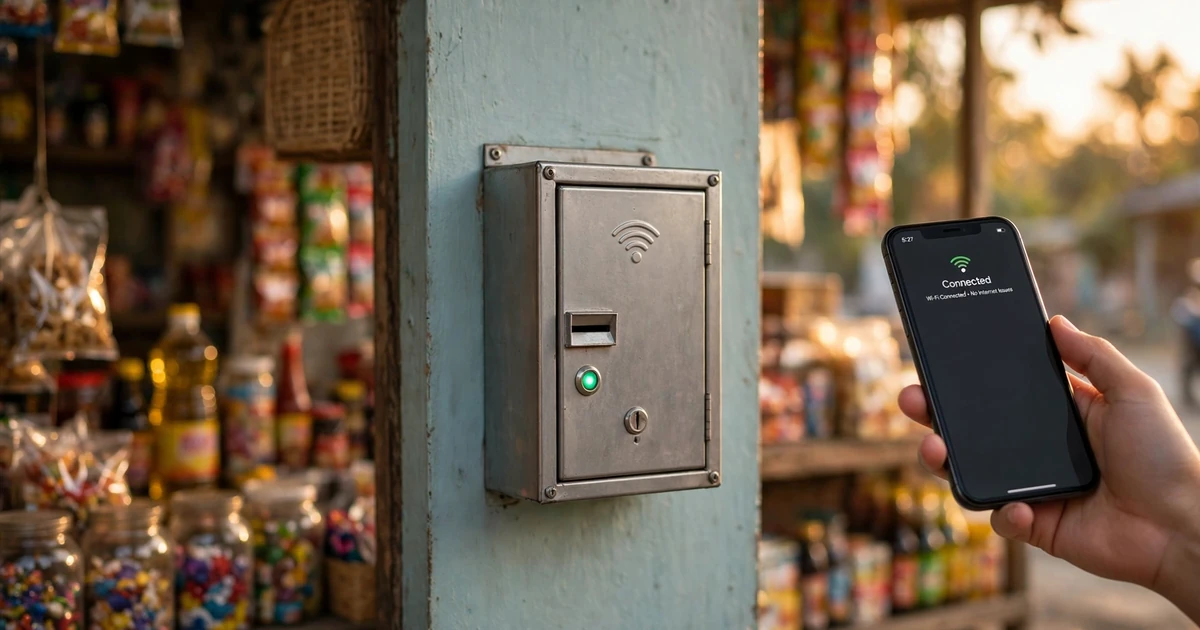
Piso WiFi is prepaid internet sold from a coin-operated vending machine called a vendo. You join its WiFi network, drop in coins, and get a block of online time. There's no subscription, no account and no SIM card to buy.
The name gives away the price model. “Piso” is the Filipino word for one peso, the coin you feed the machine.
Owners put vendos where people already wait or gather. TP-Link Philippines lists these spots:
Pisonet rents you a coin-operated computer. Piso WiFi sells WiFi time to the phone or laptop already in your pocket. Unbox PH covered the switch back in May 2016, noting that the WiFi version needs no computer stations at all.
No rows of PCs. No chairs to fix. Just a box on a wall.
Students, for one. In September 2020, GMA News reported on a vendo in Baseco Compound, Tondo, that helped students attend online classes. Neighbours used it for school, YouTube and Google searches, and they found it cheaper than buying mobile data load.
A vendo combines a coin acceptor, a small control board running vendo software, and a WiFi router, all in one case. An internet line feeds the router, and the software counts your time and runs the 10.0.0.1 portal.
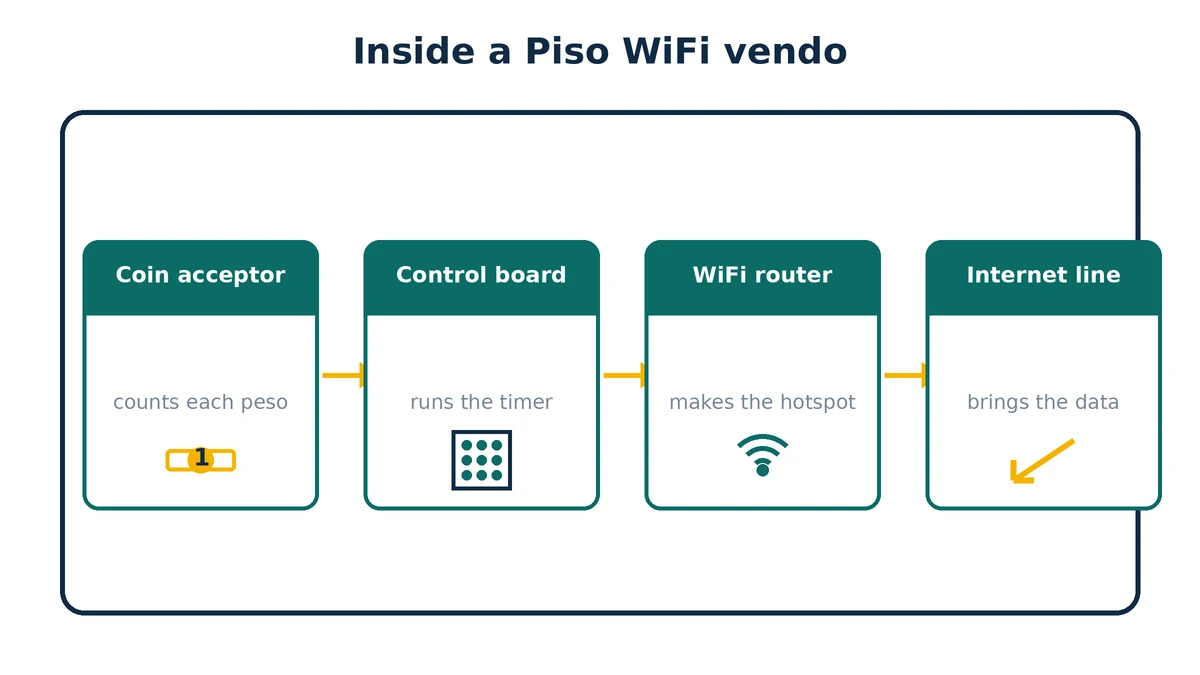
Here's what each part does, using the examples TP-Link Philippines and Circuitrocks give in their build guides:
| Part | What it does | Example |
|---|---|---|
| Coin acceptor | Takes your coins and signals the board over one wire each time someone pays | A multi-coin or programmable 4-coin selector (Circuitrocks) |
| Control board | Runs the vendo software: the timer, the rates and the admin page | Orange Pi One or Raspberry Pi 3B+ with a microSD card |
| WiFi router | Broadcasts the network your phone joins | TP-Link names its TL-MR6400, which has a 4G LTE SIM slot |
| Internet line | Brings the internet into the vendo | PLDT, Globe Fiber, Converge or a 4G/LTE SIM |
| Power | Keeps everything running | A stable outlet, plus a UPS that lasts 15 to 30 minutes (TP-Link) |
Running a vendo on satellite internet instead? Read how Starlink-powered vendos work.
Three names come up again and again:
Whichever one your vendo runs, you'll meet it through the 10.0.0.1 portal, the page where you insert coins and check your time.
You join the vendo's WiFi, open its portal, and insert coins. The vendo turns your coins into minutes and connects your device. When the timer hits zero, you're offline until you add more coins. Pause before then to save what's left.
TP-Link Philippines breaks a session into six steps:
Simple enough. Our how-it-works guide walks through a full session from coin to disconnect, screen by screen.
Yes, if the owner switched pause on. Tap Pause on the portal and your countdown freezes, so the minutes wait for you. TP-Link Philippines says LPB vendos hold a pause for 60 minutes by default, and owners can set anything from 10 minutes to 24 hours.
Here's how to pause your time and resume it on the same phone.
Each vendo owner sets the rate, so ₱1 buys a different amount of time from machine to machine. TP-Link Philippines' sample rates and a Tondo vendo reported by GMA News both give 10 minutes for ₱1 and 1 hour for ₱5.
Here's how those two price lists compare:
| You pay | TP-Link sample rates | Baseco, Tondo vendo (GMA News, 2020) |
|---|---|---|
| ₱1 | 10 minutes | 10 minutes |
| ₱5 | 1 hour | 1 hour |
| ₱10 | 2 hours | 3 hours |
| ₱20 | 5 hours | Not reported |
Spot the ₱10 row? Same coin, one extra hour at the Tondo vendo. In both lists, bigger payments buy more minutes per peso, so read the whole rate list before you drop a single coin.
Back in 2016, Unbox PH estimated that ₱1 bought about 6 minutes. Rates move, so trust the sticker on your vendo over any list online.
Want the maths done for you? The Piso WiFi time calculator turns your coins and your vendo's rate into minutes.
For the Baseco residents GMA News spoke to in 2020, yes. They found it cheaper than buying mobile data load. Your own answer depends on your promo and how long you stay online.
Yes. Owners buy a vendo or build one, connect an internet line, and set their own rates. TP-Link Philippines puts a starter kit at ₱6,000 to ₱9,000 and a complete plug-and-play vendo at ₱15,000 to ₱30,000, with earnings not guaranteed.
TP-Link's checklist for a new owner comes down to five things:
Our take? Location matters more than the box. TP-Link's own estimates put one low-traffic vendo at ₱6,000 to ₱15,000 a month, and one in a good spot at ₱12,000 to ₱30,000.
Thinking about it seriously? Start with our guide to running a home Piso WiFi business.
Every fact here comes from a public source: TP-Link Philippines' operator and pause time guides, GMA News, Unbox PH, Circuitrocks' build guide and AdoPiSoft's own site. Each one is linked below so you can check it.
Three guides sit under this page. One follows a full session from coin to disconnect, one turns your coins into minutes with a calculator, and one covers starting a vendo at home. Starlink vendos have their own section.
Every screen from the first coin to the moment your time runs out.
Enter your coins and your vendo's rate to see the minutes you get.
Costs, setup and the rules to check before you buy a vendo.
These six answers cover what the word piso means, whether you need an account or SIM, paying with GCash, why you stay near the vendo, how it differs from Pisonet, and what happens when your time runs out.
“Piso” is the Filipino word for one peso. The name tells you vendos sell internet by the coin.
No. TP-Link Philippines says you pay per use, with no subscription, registration or SIM card.
Depends on the vendo. TP-Link Philippines says machines can accept coins, QR codes, GCash or Maya, so check the payment options on the portal.
Because the WiFi comes from the vendo's own router, and its signal only reaches so far. GMA News reported that users in Baseco had to stay near the machine to keep their connection.
No. Pisonet rents you a coin-operated computer. A vendo sells WiFi time to your own phone or laptop.
Your connection stops. Insert more coins to keep browsing, or pause before then if the owner allows it.
Learn to pause so unused minutes wait for you, or read how to sign in to the portal first.